This is a test. This is a wound and how it was made. The unhealing of open flesh.
Buxom garbage times a million times the time to get rid of it. 1 million seconds is 11.57 days. How long will you live, can you actually read this, where are you now, how many hours do you work per day, how many steps did you take, what kind of steps? Million, billion, trillion, stuttering fear of expressing oneself clearly, but why be afraid? Fear of what, where does it come from? Hierarchy by machinery: Human The Beast and Need for Love, paradigm of varietas, variety: you have to understand it, see it, accept it and be it.
Buxom garbage times a million times the time to get rid of it.
1 million seconds is 11.57 days. How long will you live, can you actually read this, where are you now, how many hours do you work per day, how far is your place of work, how do you get there?
Length: There are one million millimetres in a kilometre and roughly a million sixteenths of an inch in a mile. A typical car tire might rotate a million times in a 1,200-mile (1,900 km) trip, while the engine would do several times that number of revolutions.
¥ Fingers: If the width of a human finger is 2.2225 cm (7/8 inch), then a million fingers lined up would cover a distance of approximately 22 km (14 mi). If a person walks at a speed of 4 km/h, it would take them approximately five and a half hours to reach the end of the fingers. Physical quantities can also be expressed using the SI prefix mega, when dealing with SI units. For example, 1 megawatt equals 1,000,000 watts.
The meaning of the word “million” is common to the short scale and long scale numbering systems, unlike the larger numbers, which have different names in the two systems.
The million is sometimes used in the English language as a metaphor for a very large number, as in “Never in a million years” and “You’re one in a million”, or a hyperbole, as in “I’ve walked a million miles” and “You’ve asked the million-dollar question”. Wikipedia
Living in the world of numbers, with numbers, with figures, scales, scenarios, tests, tubes, cubes, geometry. In the world of plenty, multitude, richness, bigness, grand being equal to something valuable, our lives are based on measurements and how well we see what is in front of us. To measure something puts it in a place in our rational universe. Gives a meaning and place, tells function or how something works as being as big or as small as it is in a relation to others similar in comparison to difference. We need to find the similar which pleases us, something to relate to and tell what we are not. What is me, what is within me, how do I work, what is the smallest piece of me? What can I do? What can a human being do? To do and think is the measure of me. What can I do, what am I able to learn to make and who tells me what to do, I am able to do. Should I obey? Yes, I’m humble servant to what really is. Why would anybody else define my doings when there is so little understanding of what is and who anyone really is? What kind of hierarchy inhabits around me, puts me in my place, or I think some forces try very hard to. How do I take place of mine and define myself, know myself or think I know myself? What kind of slaves or machines are we (very good ones, very good.). If we live in slavery without probably being alerted, not noticing or caring much about it. Or are we too scared to change the situations of ours. I always wonder what are we scared of. To live in fear, stop for heaven’s sake. What will happen to us if we step outside.
Calculating the possibilities of survival after an atomic attack. Counting my hair. How many cells do I have and isn’t it heavenly I survive without needing to think about them and their action? So this is a difficult task for me to get inside the world of numbers (When did I leave it? Or when was it introduced to me thoroughly?) and maybe understand how the world works or working makes it, makes me possible, makes us as we make it. It has taken me a long time to realise where numbers come from, what are equations, theorems, a language too difficult for many, what it means. History of Mathematics was not thought at school and I didn’t realise the beauty of numbers until now that I understood that Physics and understanding it was so vital of understanding existence. Hah. Everything and everybody by numbers and movement, reactions. Numbers entail order, amount, structure, aristocracy, hierarchy, secrecy and the truth, reality and mystery, mistakes. Those who understand and those who don’t.
The use, to use, utilise, make things happen. What things? Mobilise us, make our lives faster, things in our lives to happen rapidly, information to pass forward, to let know what happens, why and when. Knowledge and how far we drift from it the more we have exposure to it, access to it, what are the things we want to know and things we don’t want to know. What is important to know and what we need to know. There are people who don’t want to hear about the bad, the ugly, the truthful, let’s concentrate on the happy things and have a cup of something. The easiness of not knowing is a kind of relief and stressless state. To turn one’s back to the pile of thrash for example. Someone who has not seen the struggling and the pain will be shocked and someone who has seen those things a lot is used to bad things, expects them to happen. It exists in my world, the bad. Is that how it goes or is it different kind of struggling and pain we all experience being unable to connect, because we either minimise or do not see other people’s struggles or don’t want to get involved? How do you suffer, is your suffering big or small, do you make it known for others or keep it to yourself? What makes it big or small, do you talk about it a lot or not at all? How to measure the amount and intensity of one individual’s pain? What creates pain? Is it the shame of not knowing what it means or just because of hurt? The opposite of pleasure, lack of pleasure or inability to understand pleasure. How much pain can a person take, like when tortured? Sure, ache is different with different reasons. Some take more than others. What causes ache in people’s lives? Why is life so full of pain caused by hurt caused by suckers and motherfuckers? To kill, to murder, we want to see murder to see someone suffer. We want to see suffering to ease our own hurt. To see fear on someone’s face and laugh at it. I’m glad it was not me. To that person who is afraid. Why is causing pain like a machine in us? What is the machinery in us that ticks pain. It is machine-like activity that is fairly easy to guess and calculate. How certain kind of people think and act, in which social level, with whom are you seen with. The rules and hierarchies moving people and their mind tick like clocks. One cannot make a mistake once you know the patterns how. It is dangerous to see through. Unavoidable, inescapable quality of human life, suffering and how people survive and learn. If you suffer you must make the other suffer too. Could you learn away from that feeling and the need to revenge? To let know how one feels inside, a circle that never stops. Revenge, ignorance, selfishness, indifference make people function and create hate, war, famine, death and poverty. It is to blame human nature and it cannot be changed, shit happens? That is how it looks.
How everything happens, everything – saying out loud is tiring, the all and what we know about it what is around us and why it happens as it does. Not a break, not a sigh or time to rest, but observe and know more and think how one changes and absorbs. There is no time to stop. This is to understand what I know or think I know, what there is to know.
This is calculating the possibilities of survival during and after. Probability of survival estimated is like planning a trip to. Asking questions, questioning stupidity, which is thinking of knowing but still not knowing much, but that we are machines. Western heritage is about knowing the truth, what is right, being on the side of facts and what is good. It is the heritage of Christianity and science, history of conquerors and winners. To rule as a white male, a meat-eating hero, the conqueror who says rabbits eat vegetables. Is it to say you are better than the rabbits, it doesn’t show. How you evolve tells how good you are, not what you think you should be, but you make of yourself and stay that way thinking this is the best there is, a state of evolving. Do I have the same goals, the same direction as everybody else? Which strange goal I’m part of, where does it go and what is it, this goal of ours, this conqueror we still desire to be, where do we want to go, this set of systems we have created. I am a living system in the set of systems, we are bunch of systems systematically and without a clue trying to calculate the ways to manage, but not knowing, shooting in the dark still. I am puzzled. Systems that aren’t serving humanity and nature, but destroying them are strong. Softer ways somehow do not easily win. Is it possible to get rid of systems that we have created and build new ones? Dependency on money, vehicles, machines, electricity, food supply, media which make high-speed a value. Could we live without this regime of speed or just have few of them? It is a question of what we want life to be. How we want to live it. Fast, hedonist, proud, ambitious. Do we have to give up everything of that wealth we have made to save ourselves and others. What do we essentially need? What are human needs? Is it speed?
It is a strange feeling a movie being an organism that becomes part of you when you watch it and it remains with you afterwards. You are familiar with it but there is an element of unexplainable and the issue is of something that is not emptied. It is not just series of breathtaking images put on screen to take the viewer to another place. There are movies to entertain and bring instant pleasure, this is something else which is extremely difficult to point out without sounding an ecstatic fool stating the obvious, the brilliance and beauty there is, divine and timeless, but still rooted in time and place, to us. It is not extraordinary to hear male voice of critics, those who watch and love movies and so often disregard the feminine side there is clear and strong but somehow invisible for the male. To me it is loud as is the dogs barking in the fog and the sound of heels in a church where woman of the film is slowly walking like moving in a mystery and learning to know it. It also is not unusual to hear male directors say they did not realise how powerful the female protagonist really is for the female viewers. What is this woman doing she who walks like a queen into something ancient like a tourist, in to the old refusing to kneel down and pray and refusing to want the same which she should be wanting naturally. A surprise for her is how she is not able to perform the same rituals as those to whom it comes naturally, how out of touch she is. In the face of what kind of movies get made nowadays it is ironical to state harsh critique for Nostalghia. In many cases of movie critique subjectivity is speaking. Art is sensitive to the word of experts who give their final say and I have found the official standings on films often biased and unfair. Being judgmental towards something so delicate and precious is almost blasphemy as it is easy not to look. Is there same disinterest as there is disinterest and underestimation towards the feminine altogether I wonder. The public believes the experts. Experts know best. They have authority. To have faith in experts is one kind of religion we should learn to be more critical about. Pay attention the woman is driving and stops because she chooses to have a walk.
My attempt is to be as analytical as possible. What it is I am watching. As much as there is room for objective analysis in art and for Tarkovsky, there is emotion and devotion to his art and much of art analysis and critique have personal liking and opinions weighing in on the whole of what is being said about a piece of art and the artist. Nostalghia (1983) and Sacrifice (1986) are often said of being less good and artistically not as high in artistic quality, innovation and expression as Stalker (1979), Mirror (1975) and Andrej Rublev (1966) which all bring in front intensity of faith and religion in Russian culture and thinking, which was at Tarkovsky’s time an atheist country. Russia being an intensely macho country where worshipping the Mother of God hasn’t faded. The nurturing mother has important task and nurture especially which is part of the sacred. Highlighting the female for Tarkovsky functions as Ellen Ripley in the Alien movies. Her power is under serious doubt and seen as fragile, but she has it anyway and she uses her power to save the world.
Nostalghia struck me as it highlights the feminine, how faith is part of our bodies and what we see, how we look, the divine is in the feminine and there is the unbreakable link to nature, women’s desire to be mothers and have faith to the unknown, or not. To my mind the film is an exemplary exploration to how much one is master of one’s destiny and how the modern brings in and strengthens the conflict between nature and man, conflict between the sexes is a constant battle. For women to have a mind of their own is the modern and natural, they do their thing, the question is what is the thing of women, with women, what is theirs to have, for them. With the modern something happens to the collective, ideals and to the common good towards which to be nostalgic about is fair. Something happens to the individual in this process, the estrangement, loss and loneliness, an inner and outer conflict, a disaster. Question is what do we become? To be an organic part of nature bearing children, being a child and finding harmony there in simple things may be too simple there where there now is very little space for the harmonious and simple things. Choosing to be a traditional mother, a figure part of the sacred or a modern independent woman who has a say over her body and what she does, whether she believes or not, is liberty woman is not willing to back away from.
How much my admiration does justice to his art or does it cloud my judgment is probably a footnote. What is there on film that one senses, sees, feels, smells, hears, thinks, imagines via Andrey Tarkovsky’s movies as they are so packed but delicate, light, fragile and alive. Maybe that is it the moving part, essential aspect in his films how alive they are, how much emotion there is without frivolous nonsense as people in his films are sick of nonsense, sick of grandiose and sentimentality. There is sincere interest in human existence and how we experience, why feel the way we do and be trapped by feelings, how these personal experiences can be shown and be understood by others as the same. That is the true strength there, will to understand and look what is so felt, what is subjective and universal, the universal emotional to be understood which today is one difficulty we face as we are like images not revealing multiple dimensions on screen. How and why we can try to understand the other and be compassionate. Interesting is what makes a movie scene and an image sincere is the flaw, mess, ruin of ours. So much so that we believe in it and identify with it, absorb the view as if it was something to breath.
Fragility in a scene where a man holding a short white candle protecting its flame begins a task that seems irrelevant and pointless but is far-reaching. He has stepped inside an empty pool and begins to walk with a candle from one side to the other. Bottom of the pool is rocky, he takes careful steps. He touches the edge of the pool with his hand like it was a game as he begins and walks to the other edge trying to keep the flame burning. He fails a couple of times as the candle goes out, his frustration shows, he is seemingly tired and exhausted but he must hold on because he is determined and must keep the candle burning as he walks to the other side of the pool. He finally manages at his task gently holding the candle as it was his child, protecting it with his hand and coat as if he grew old while completing his task and died after having placed the candle on the edge of the pool and left it burning. It is an emotional scene, exhaustively beautiful, slow, painful for the viewer, grounded, vividly depicting a state of mind, an any man’s effort which is so packed and painful viewer feels the torture of failing and trying again and relief of succeeding finally as if it was a physical sports exercise. Close-up to the hands and the candle, heavy breathing.
I experienced Nostalghia as something which very few have been able to achieve on film for me. A personal astounding voyage into details which speak via femininity and a child, there is no one like Tarkovsky and his vision and it makes me wonder why so. Is it the extreme conditions of banning and spying on citizens, a doctrine of political that has no place for mystery and belief to the invisible, something hovering in the air is an escape from Social Realism and banning God. Tarkovsky’s movies speak the spiritual, spirit rains down and over endlessly or burns violently which happening is viewed on film by actors and me outside, what is there to see is a miracle of nature, to get soaked in rain is a spiritual happening like being baptised again and again and denying the divine is the ultimate crime against people and the spirit. The power of his films and this particular film is something of rare kind but still very everyday and everywhere, suffering and beauty of suffering, what becomes of suffering, what is to suffer, how to overcome this conflict and what does it make of us. Nostalgia is what all feel when looking back, the subjective view and what we remember is only for us. To share that personal view can be impossible, the subjective experience in time. Viewing breathtaking images of landscapes and historical buildings longing for release from the modern machine and finding momentary joy has such heaviness and weight it is unbearable as is the beauty in Tarkovsky’s movies. All is beautiful because all comes from God, all is light as all is heavy. How can we show our respect towards what we have and what is?
You can watch the film without knowing what the story is. That it was made over 20 years ago is almost irrelevant, but telling. There is something to the point that the woman is an interpreter and the male protagonist is a writer doing research. We are drowning and burning in the very same way as tragically, suddenly and sadly, watching people go by, who are they the couple asks. To be in search of and inquisitive has a purpose. Things happening around must have a reason. Times are in contrast to the slowness and pace, massiveness and weight of nature feels like a landslide taking us by our feet and pulling us down with the freezing stream. We are still protesting as we were then and remain completely dissatisfied with the ways we are managed, screwed and administrated, expected to accomplish, make, go by the book and be going somewhere as the taxi is waiting, luggage is packed and we are moving ahead somewhere forward not back in time but into the future. Not staying put, refusing to rot but still rotting as the houses and ruins in the film do. Rain comes through the roof, puddles become ponds on the floor and man wades and paddles in clear water inside ruins where there are landscapes, rivers and hills, bottles collecting the rainwater and a dog looking at the camera. Sounds and images are of beauty that is constantly being made by nature, humans wetting their shoes and clothes as they do not have any choice but go in and get wet. In Nostalgia there is fog and rain throughout all of the movie, sudden blink of sunlight lasts only a few seconds and it rains again. People don’t complain about the weather but they are in pain and in inescapable situation brought by their bodies, nature and other people, unbearable. Some go crazy which seems to be the sanest and most obvious thing to do. Don’t go with the flow, follow your own nature, if it is yours, if you understand what it is, if you know how to look and what really is beautiful, what is beauty of yours.
To be surrounded by water, be in water, face the inescapable flooding, wetness of clothes and hair. Woman sitting on a bed drying out her hair with blow dryer at a comfortable hotel among other guests who wander around bumping into each other at the corridor just as you, but not as poor as you, not as lost as you, not as wet as you, not as tired, not as out of their minds. There is no union, no true meeting, no coming together, people go their separate ways asking what is happening, not knowing is one cause of suffering. To dry out and never get dry is what tires people out to the limit of setting oneself on fire standing on a statue. Warmth comes from a bottle. Hotel guests are free to take refreshing and rejuvenating baths while a crazy homeless man goes around the pool in wet shoes. He is a poet, listen to what the poet says. Water is safety and saviour. It is about birth, divinity, life on earth, a cold shiver, death, drowning, drinking, listen to it. This is not a desert as it is not dry, maybe dry of joy. Life lies in the water with divinity which becomes at birth in opening the dress of the sacred mother from which birds fly out after a prayer is spoken to become a mother, please bless me. Candles are still the warmest of all to be protected at the altar melting bringing in light lighting up the place and prayers of women who wish to become mothers and those who are graciously blessed are with those who await. We are in water also at birth, our reflection is in the water, our becoming happens because of water.
To embody beauty and the divine, the sacred and the spiritual is what Tarkovsky’s movie Nostalghia does. It is the main theme for him which enlarges itself as his movies are few and monumental pieces of art finding out spirituality and the killing of it. Significance to a movie fan is as massive as historical paintings and buildings have, what are we without knowledge of history. Hair on a woman is the same as vegetation moving along with the stream of water in which there is a fallen statue of an angel. It makes one think every breath taken and held, hold breath and breath out, think about breathing, how the water feels on one’s skin and how that statue does not feel a thing, it does not know where it is. Russia is always there even though the movie happens in Italy. Italy seems the same as Russia, people are the same, beauty, meaning and purpose of religion, ruins, history, sentiments, sentimentality, there is something so similar that it is all one. Fight is the same, poverty is the same, suffering and relationships, problems do not differ. What is the desert here and why? The crazy man in the movie shuts off himself with his family in their home for seven years in isolation. They were rescued as if they had wrecked a boat at sea and been saved in the last minute, a mega spectacle of saving a family. With such small size Tarkovsky paints a profound image where Beethoven is only too pompous and royal, imperial and full of himself, played when something important happens and must be paraded. Beethoven and the equestrian statue on which to climb and set oneself on fire alone with a canister of gasoline while other protesters watch, the burning man falls to the ground. He was the crazy man and now he is dead. Statue remains.
”Andrei meets and befriends a strange man named Domenico (Erland Josephson), who is famous in the village for trying to cross through the waters of a mineral pool with a lit candle. He claims that when finally achieving it, he will save the world. They both share a feeling of alienation from their surroundings. Andrei later learns that Domenico used to live in a lunatic asylum until the post-fascistic state closed them and now lives in the street. He also learns that Domenico had a family and was obsessed in keeping them inside his house in order to save them from the end of the world, until they were freed by the local police after seven years. Before leaving, Domenico gives Andrei his candle and asks him if he will cross the waters for him with the flame.” https://en.wikipedia.org/wiki/Nostalghia


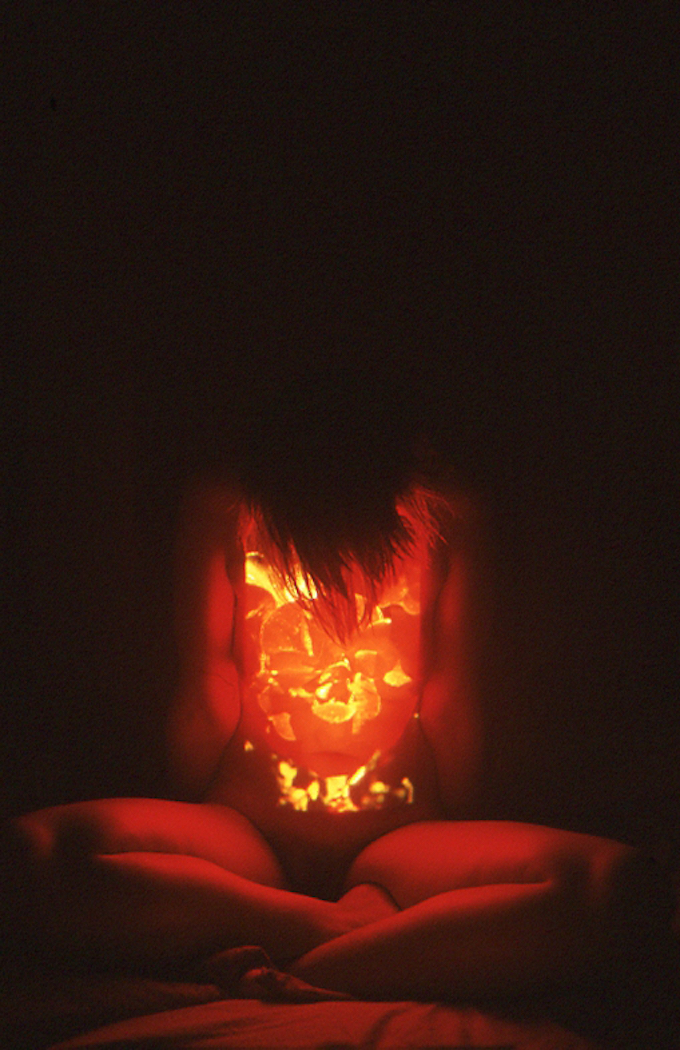


 Majakollektiivi Timanttimetsä